TLDR: Choose an open edition when you want ongoing availability, flexible reordering, broad access, or room to test demand. Choose a limited edition when a finite release supports the work and you are prepared to define, document, and honor the limit. The edition label does not determine reproduction quality: an open-edition print can be made with the same careful capture, color management, paper, ink, and proofing as a limited one.
The practical difference in open edition vs limited edition prints is availability. An open edition has no stated production cap. A limited edition has a maximum quantity established before or when it is released. That limit is a promise to buyers, not a printing technique and not an automatic mark of better materials.
For the artist, the choice changes how freely a print can be replenished, how much recordkeeping the release requires, and what buyers can reasonably expect after it sells out. It does not change the central production question: does the reproduction still carry the color, line, surface, and mood that make the original work distinct?
Open edition vs limited edition prints at a glance
| Decision factor | Open edition | Limited edition |
|---|---|---|
| Quantity | No stated production maximum | A defined maximum quantity |
| Availability | Can remain available and be reprinted as demand continues | Ends when the disclosed edition is sold or otherwise closed |
| Reordering | Flexible; suitable for print-on-demand or periodic batches | Allowed only within the edition’s remaining quantity and stated terms |
| Documentation | Basic product and production records are still useful | An edition policy and accurate edition log are important |
| Buyer expectation | Access and continued availability | Finite availability under the disclosed terms |
| Best suited to | Evergreen work, broad access, demand testing, repeat sales | Collector-focused releases and projects built around a finite run |
| Print quality | Determined by capture, file preparation, ink, paper, printing, and proofing | Determined by the same production choices, not by scarcity |
The Fine Art Trade Guild describes a limited edition as a finite number of copies and treats edition size as a publishing and marketing decision rather than a technical production limit. Its material is UK trade guidance, however, not a universal legal definition that applies in every country.
When an open edition is the better choice
An open edition is usually the more practical format when your priority is keeping the image available. You can produce small batches, replenish stock after a popular event, or continue offering a design without predicting its lifetime demand in advance.
It is especially useful for an evergreen illustration, a popular landscape, or an accessible entry-level print. If you are introducing reproductions for the first time, an open edition also lets you learn which sizes and papers buyers prefer without committing to an edition structure too early.
- Choose an open edition if you want to test demand before carrying substantial inventory.
- Use it when broad access matters more than scarcity.
- Prefer it when you expect to change fulfillment methods or order in small, recurring batches.
- Consider it for lower-priced formats intended to remain part of your regular catalog.
- Use it when you do not want a sold-out edition to prevent future sales of the image in that format.
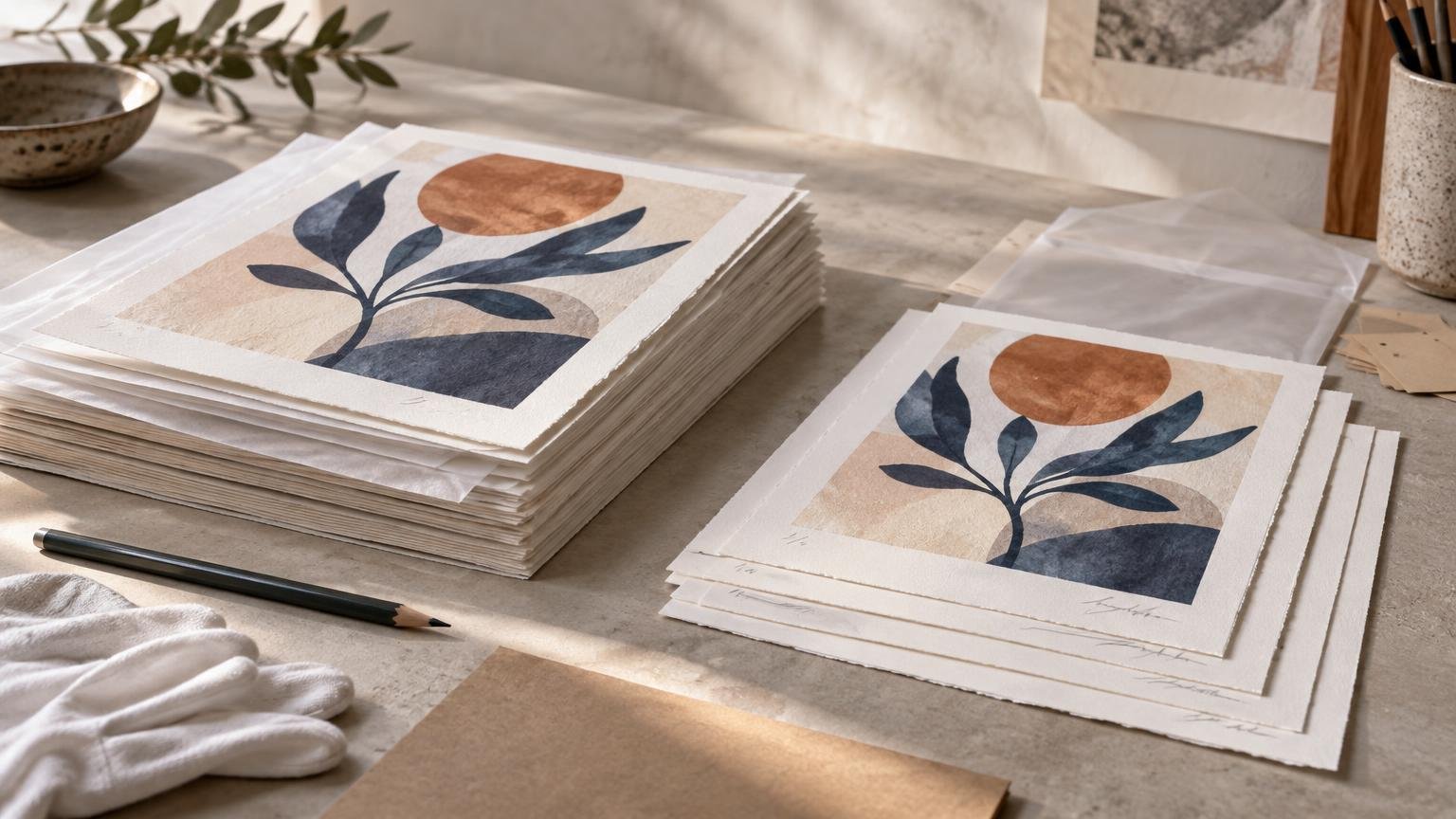
Open does not mean careless or disposable. You can sign open-edition prints, use a carefully selected fine-art paper, approve a master proof, and keep production specifications so later batches remain consistent. The label only says that you have not promised a fixed production ceiling.
When a limited edition makes sense
A limited edition works best when finiteness is part of the artistic or commercial idea. That might be a special release tied to a body of work, a hand-finished variation, or a collector-oriented print produced under tightly controlled specifications.
The key question is not whether a smaller number sounds more exclusive. It is whether you can explain the limit clearly and continue honoring it years later. Do not choose a quantity merely because it seems conventional. Consider your audience, likely demand, production capacity, price, storage plans, and how long you want the release to remain available.
An edition of 25 may suit a labor-intensive print that receives individual handwork. A cap of 100 may fit a release intended for a larger audience. Neither number makes the image inherently better or more valuable. The useful number is one that matches the project and that you can administer without changing the rules after sales begin.
What does 14/50 mean?
A notation such as 14/50 normally communicates that the print is numbered 14 in an edition capped at 50. The denominator is the important availability promise: buyers understand that the stated edition contains no more than 50 prints under that description.
Numbering is clearest when paired with a written policy. Buyers should not have to guess whether the limit applies across every size, only to one size, or only to a particular paper. A signature alone does not turn a print into a limited edition; the defined and disclosed cap is what distinguishes the release.
Define the edition before selling the first print
A strong limited-edition listing tells the buyer exactly what is finite. Write these terms before the first sale, then preserve a copy of the listing and maintain an edition log.
- Artwork title and, where useful, the completion or release year.
- Maximum number of prints in the edition.
- Finished image dimensions and paper dimensions.
- Paper or other print medium.
- Printing method and any hand-finished elements.
- Whether the edition is signed and where the number will appear.
- Whether different sizes share one total limit or have separate limits.
- Whether artist’s proofs, printer’s proofs, or other proofs exist and how many.
- Whether the edition applies to one paper, colorway, or presentation format.
- What will happen to damaged prints, production overruns, and unsold stock after closure.
There is no single policy in the supplied guidance requiring all sizes to share one edition or requiring each size to have a separate edition. Either structure can be understandable if disclosed in advance. For example, you might offer one edition of 60 across all sizes, or separate editions of 40 small and 20 large prints. State the structure plainly rather than making the buyer infer it.
A certificate of authenticity can repeat the title, dimensions, medium, edition number, artist’s name, and release details. It documents the policy; it does not repair an unclear listing or substitute for an accurate edition log.
What happens after a limited edition sells out?
Once the disclosed edition is complete, do not quietly replenish the same product. If future use of the image matters, reserve that flexibility before launch and explain it. You might limit one signed paper size while keeping postcards or a clearly differentiated open-edition format available, but buyers should know that arrangement from the beginning.
A materially different release should be described as different rather than used to blur the original limit. Changes in size, paper, border, or signature do not automatically resolve buyer expectations if the first listing implied that the image itself would never appear again. Precise wording prevents that conflict.
Scarcity and reproduction quality are separate decisions
Limited editions are not automatically more faithful to the original. The result still depends on how the artwork is digitized, how the file is prepared, and how consistently it is printed. Hahnemühle identifies paper-and-ink compatibility, ICC profiles, color gamut, ink handling, and aging resistance as relevant considerations in a digital fine-art workflow. Those considerations apply to both open and limited editions.
Start with a digital file that captures the important qualities of the artwork. Flat, modestly sized, low-sheen work may be suitable for scanning, while large, textured, glossy, framed, fragile, or dimensional work may need a camera setup. The practical distinctions are covered in this guide to deciding whether to scan or photograph original artwork for prints.
Then approve a physical proof at the intended size. Examine it under lighting similar to the conditions in which buyers may view it. Look beyond simple color matching: check whether pale washes remain distinct, dark regions retain separation, fine lines remain crisp, and paper texture supports rather than overwhelms the image.
Paper should serve the artwork rather than signal edition status. Smooth matte can preserve delicate linework with little surface distraction, while textured matte may complement visible brushwork or traditional-media character. Satin and gloss can increase visual punch but also add reflections. Compare these effects in a final-size proof or use the guide to matte, glossy, and textured paper for art prints before fixing the production specification.
Build a repeatable master specification
For either edition type, retain the approved print file and record the details required to reproduce it consistently. This is particularly important for a limited edition produced in batches over several years.
- Approve and archive the final print-ready file rather than relying on an editable working file.
- Record the image dimensions, paper dimensions, orientation, borders, and cropping.
- Identify the exact paper and the printer, ink set, or production provider used.
- Keep relevant color-profile and output settings with the production record.
- Date and label the approved physical proof.
- Compare later batches with the proof before signing, numbering, or shipping them.
- Record each limited-edition number, production date, sale, replacement, cancellation, and retained proof.
The same records are useful whether you print in-house, work with a fine-art specialist, or compare commercial printing options for other formats. Production methods can change, so the approved proof and written specification give you a stable reference for deciding whether a new batch still represents the work properly.
A narrow legal note about the 200-copy figure
Artists sometimes encounter a U.S. reference to editions of 200 or fewer. In the federal definition of a “work of visual art” used for the Visual Artists Rights Act, 17 U.S.C. § 101 includes certain signed and consecutively numbered editions of 200 copies or fewer. That language serves a specific statutory definition; it is not a general rule that every limited-edition art print must contain 200 copies or fewer. You can read the wording in 17 U.S. Code § 101.
Edition terminology, consumer expectations, contracts, and legal treatment can vary by location and circumstance. If a release has substantial financial or contractual implications, obtain advice appropriate to your jurisdiction rather than treating a trade convention as universal law.
A simple decision rule for your next release
Choose an open edition if your honest answer is, “I want this image to remain available while there is demand.” Choose a limited edition if your answer is, “This specific release will stop at a clearly defined quantity, and I can track and honor that commitment.”
A hybrid catalog can make sense. An artist might keep an evergreen illustration available as an unsigned open-edition print while releasing a special large-format version as a signed and numbered edition. The distinction should be visible in the size, medium, finish, handwork, or presentation—and explained before either version is sold.
Your next step is straightforward: approve one physical proof, decide whether availability will be ongoing or finite, write the policy in plain language, and create the production record. If the release is limited, start the edition log before listing print number one. Scarcity may shape the offer, but faithful capture and repeatable printing are what help the reproduction continue to feel like the original artwork.