
TLDR
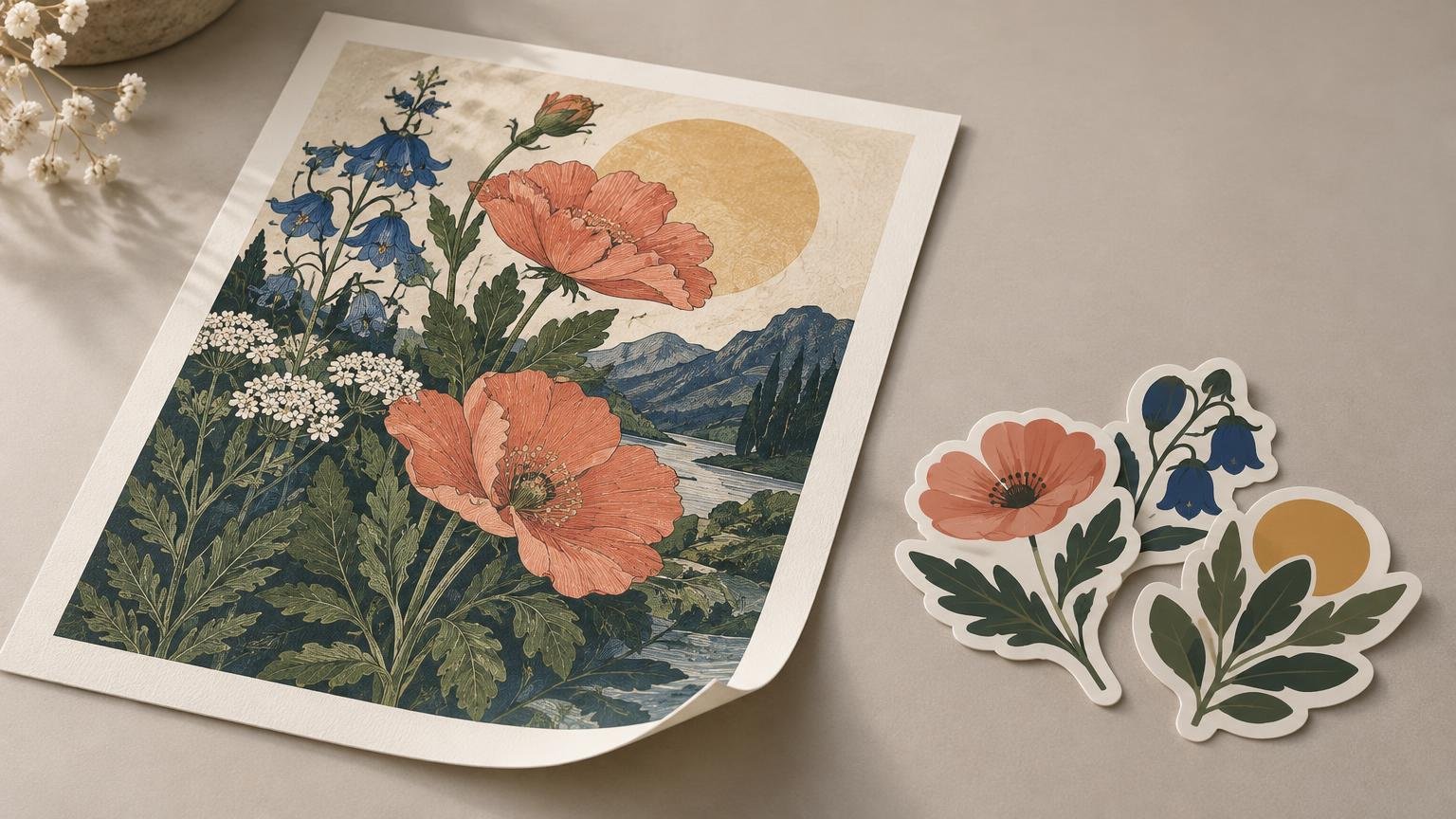
Choose art prints when the work depends on scale, fine detail, tonal range, surface character, or collector-oriented presentation. Choose stickers when the design is bold, recognizable at a small size, and suited to portable self-expression. If you are weighing art prints vs art stickers which products make sense for artist merch, do not assume one must replace the other: use both only when each format has a distinct job.
A sensible first assortment is one flagship print, two or three genuinely sticker-ready designs, and perhaps one bundle connecting them. Proof each product at its actual size, calculate the complete cost of fulfilling an order, and expand only after real sales show what your audience wants.
Art prints and stickers serve different buying occasions
A print invites someone to give the image space on a wall, shelf, or desk. Its appeal can come from the composition as a whole: distant marks, subtle transitions, paper texture, or the relationship between large areas of color. Presentation choices such as size, paper, border, edition, and signing become part of the object.
A sticker usually works as a compact symbol. A buyer might put it on a notebook, case, storage box, or other suitable surface. The strongest sticker designs communicate quickly through shape, contrast, character, or a short phrase. Small scale is not merely a cheaper version of a print; it is a different design condition.
| Choose | When the artwork depends on | Typical product role | Main preparation priority |
|---|---|---|---|
| Art prints | Detail, tonal nuance, texture, atmosphere, or a complete composition | Wall display, gifts, portfolios, or collector purchases | Faithful capture, proofing, paper choice, and presentation |
| Art stickers | Bold silhouettes, emblems, character crops, strong contrast, or short text | Portable expression, small gifts, add-ons, or accessible merch | Small-size legibility, contour, border, and format |
| A focused mix | A complete image plus one or more strong motifs within it | A flagship piece supported by lower-cost companion products | Give each format a distinct purpose rather than duplicating everything |
When art prints make more sense
Start with prints when reducing the artwork would remove what makes it compelling. A layered landscape, detailed architectural drawing, soft watercolor portrait, or richly shaded digital painting may need enough physical area for the eye to travel through it. A print can preserve the full composition and give quieter passages room to register.
Prints also provide more room for deliberate presentation. You can choose a paper whose surface supports the image, leave a border for handling or framing, sign the work, and decide whether the image will remain continuously available. If paper is still an open question, compare matte, glossy, and textured art-print papers using final-size proofs rather than judging from a screen alone.
Prepare the reproduction before designing the product listing
The print workflow begins with a suitable digital master. Flat, safely handled work may be scanned, while oversized, textured, reflective, framed, dimensional, or fragile pieces may need to be photographed. The choice should follow the original artwork, not simply whichever device is nearby. This guide to scanning or photographing original artwork explains the practical differences.
Next, correct the capture carefully, choose a reproduction method and paper, and order a proof at the intended sale size. Inspect fine marks, neutral areas, dark detail, gradients, cropping, and border width under useful viewing light. A beautiful file is not yet a successful print; the physical proof is where paper, ink, scale, and handling meet.
Avoid broad promises such as “archival,” “fade-proof,” or a precise lifespan unless the specific paper, ink, printer, and relevant testing support them. The Library of Congress preservation guidance notes that longer-lasting digital prints use pigment-based ink with paper optimized for the ink and printer, while light damage is cumulative and irreversible. Describe the materials you actually use and give buyers realistic display and care information.
Edition language needs the same precision. An open edition remains available without a stated production cap; a limited edition has a fixed maximum quantity. Neither term automatically establishes print quality. Before numbering work, understand how open and limited editions change production and buyer expectations, then state the size, edition limit, signature details, and included documentation consistently.
When art stickers make more sense
Stickers suit artwork that survives reduction. Strong candidates include a character’s face, a plant silhouette, an animal outline, a hand-lettered phrase, a small emblem, or one recognizable object lifted from a larger scene. The buyer should understand the design without studying it from inches away.
Test this by displaying or printing the design at its intended physical size. Check thin lines, small gaps, facial features, lettering, and dark areas that may close together. If the image becomes muddy, simplify it, increase contrast, remove secondary detail, or create a purpose-built crop. Do not keep shrinking the complete illustration simply because the original file fits inside the template.
The cut and construction should support the design. A die-cut sticker follows the outer shape; a kiss-cut sticker leaves the design on a larger backing; a sheet groups several stickers; a pack collects separate designs; a roll supports repeated dispensing; and a clear sticker can use transparency as part of the presentation. The best option depends on how the buyer will handle and use it, not just how it appears in a product mockup.
Vendor offerings and order policies differ. YouStickers states that its standard custom stickers use thick white vinyl with permanent adhesive and lists formats including die-cut, kiss-cut, clear stickers, rolls, and packs. It also states that standard custom stickers have no minimum, while clear stickers have a minimum of 50; these are vendor-specific terms that should be rechecked before ordering. Artists ready to compare a live commercial example can review its custom sticker formats and ordering options. For a broader vendor and file-preparation comparison, see the guide to sticker printing options for artists.
Before placing a larger order, compare the intended size, cut line, backing, finish, quantity, and proofing process. Other custom sticker printing options may use different materials, minimums, and file requirements, so evaluate like-for-like configurations rather than choosing from a headline price alone.
Do not force every image onto both products
A product range feels more intentional when the format follows the artwork. Imagine a detailed nocturnal city illustration with dozens of windows, reflected light, and small figures. It may work beautifully as a medium or large print but collapse into visual noise as a small sticker.
Instead of shrinking the whole city, pull out a companion motif: one glowing shop sign, a cat in a window, or the moon above the rooftops. The print carries the atmosphere and narrative; the sticker carries an instantly recognizable piece of that world. They belong together without making the sticker feel like a compromised miniature.
The reverse can also be true. A simple mascot designed around a compact silhouette may make an excellent sticker but feel sparse when enlarged as a wall print. It could still become a print if you create a fuller composition around it, but enlargement alone does not add visual substance.
Calculate whether either product makes financial sense
There is no universal winner on profit. A low unit cost can be misleading if the product requires extra packing time, tracked postage, replacement stock, or a platform fee that takes a meaningful share of a small order. Likewise, a higher-priced print can carry substantial production, packaging, and fulfillment costs.
Build the calculation from your own numbers. For each product, record:
- Product cost, including proofs and any setup charge allocated across the order
- Packaging materials such as sleeves, backing boards, rigid mailers, envelopes, labels, or protective tissue
- Postage and any difference between domestic, international, tracked, and untracked services
- Marketplace, storefront, listing, transaction, and payment-processing fees that apply to the sale
- Your labor for file preparation, quality checks, signing, packing, labeling, customer service, and stock management
- A reasonable allowance for damaged items, lost shipments, misprints, and replacements
- Taxes or required collection costs relevant to your business and location
Subtract the complete per-order cost from the amount you actually receive after discounts and fees. Run separate examples for a sticker-only order, a print-only order, and a combined order because packaging and postage may change. Also consider cash tied up in unsold inventory. A product can show an attractive per-item margin yet still be a poor launch choice if reaching that cost requires buying far more units than you can reasonably sell.
Start with a focused test assortment
For a first release, choose one flagship print that represents the work at its strongest. Add two or three stickers designed for small-scale recognition rather than converting the entire portfolio. An optional bundle can pair the print with one related sticker, but price and describe each component clearly.
Track actual orders, not just compliments or social-media reactions. Note which designs sell, whether buyers combine products, how long packing takes, what damage or replacement issues appear, and which questions recur. A modest test makes it easier to improve files, descriptions, packaging, and prices before committing to a wide catalog.
Check reproduction rights and describe the product accurately
Only reproduce artwork you own or have permission to reproduce in merchandise. This deserves special attention for commissions, collaborations, licensed characters, fan art, gallery-represented work, and pieces created under employment or client agreements. The U.S. Copyright Office’s visual-art guidance explains that copyright owners hold rights that include reproduction, distribution, preparation of derivative works, and authorization of those uses. A physical original changing hands does not by itself answer who may reproduce the image; check the applicable agreement or license.
Finally, make the listing match the object. State the print size, paper or media, border treatment, edition status, and whether a frame is included. For stickers, state the dimensions, material as provided by the manufacturer, finish, format, quantity, and any relevant application limitations. Avoid unsupported permanence or durability promises.
Choose the format that preserves the idea
The best merch product is the one that lets the artwork make sense in its new form. Keep detailed, atmospheric, and composition-led work at a print scale where it can breathe. Turn bold motifs and readable crops into stickers that feel complete in the hand. Begin with a small, deliberate range, calculate every cost, and let real orders guide the next expansion.