
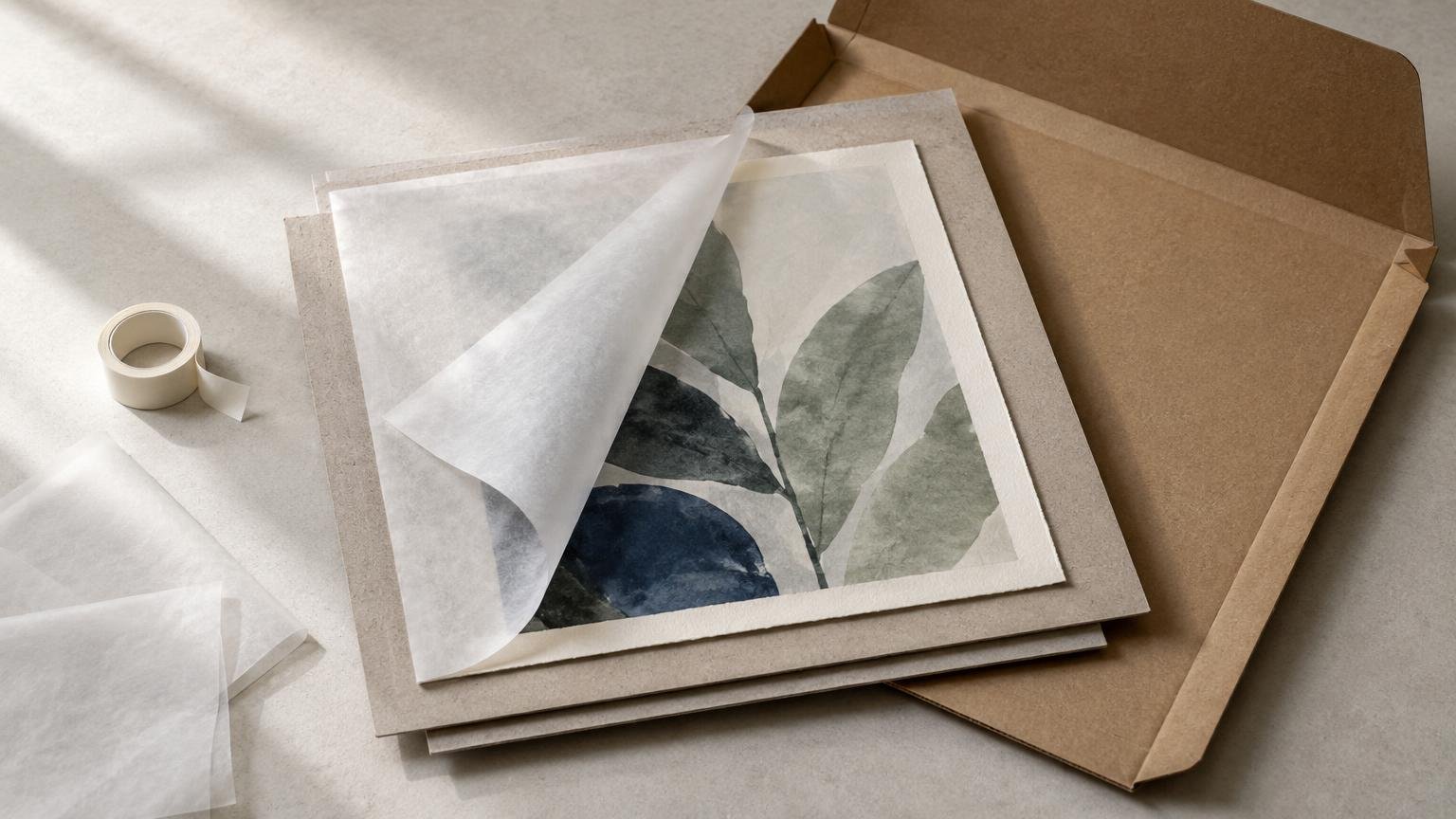
To ship an unframed art print flat, protect its surface with a clean enclosure or separator, place rigid support on both sides, and use a close-fitting outer mailer or box. The surface layer prevents rubbing; the boards and outer package prevent bending. Neither can do the other’s job.
TL;DR
- Let the print dry fully, then handle it only by clean edges.
- Place the print in a clean enclosure or between smooth separator sheets. Use acid-free material if it will remain with the print for storage.
- Sandwich the protected print between two rigid boards that extend beyond every edge.
- Put that sandwich in a close-fitting rigid mailer or shallow box so it cannot slide or flex.
- Seal the parcel securely and check for movement before shipping.
- Treat a “Do Not Bend” label as an instruction, not as structural protection.
Use three separate layers of protection
Successful print packaging is easier to plan when you divide it into three jobs: protect the image surface, stiffen the print, and contain the reinforced bundle. A sleeve without boards can still bend. Bare boards can rub against the artwork. A large box can allow the contents to gather momentum and strike its sides.
| Layer | What it protects against | Suitable approach |
|---|---|---|
| Surface layer | Scuffs, fingerprints and print-to-print contact | A clean enclosure or smooth separator sheet |
| Rigid sandwich | Bending, folding and damaged corners | Firm boards or corrugated pads on both sides |
| Outer parcel | Impact, shifting and exposure during handling | A close-fitting rigid mailer or shallow box |
The Canadian Conservation Institute’s artwork transport guidance treats abrasion, shock, vibration and impact as distinct risks. That is a useful way to think about a parcel: adding more of one soft material does not necessarily solve a lack of structural support.
1. Let the print dry before it touches packing material
Do not move a fresh print directly from the printer into a sleeve. Allow it to dry fully under the conditions recommended for the ink and paper, and inspect the surface in clean light before packing. Epson advises keeping media dry, handling it carefully and avoiding moisture, skin oils, rubbing and scratching. Epson’s media-handling guidance also recommends separator sheets when prints are stacked.
Handle the sheet by its edges with clean, dry hands. Clear loose paper dust from the work surface, and remove any grit from boards or enclosures. A nearly invisible particle can become a visible mark when it is pressed against a dark or heavily inked area for the whole journey.
2. Protect the printed face from rubbing
Place each print in its own clean enclosure or between smooth, clean sheets. Do not stack bare printed faces together. Individual separation is especially important for textured matte papers, which can show visible scuffing even when the ink itself resists scratching. If you are still selecting a surface, the practical differences between matte, glossy and textured paper for art prints include how readily handling marks and surface character become visible.
Choose acid-free tissue, paper or board when the contact material will stay with the artwork after delivery or become part of its storage. Acid-free does not mean rigid, however. A conservation-grade tissue may be appropriate against the print while offering almost no protection from a bent parcel.
Keep adhesive away from the artwork. If you tape an enclosure or secure the rigid boards together, place the tape where it cannot touch the print even if the package shifts. The recipient should be able to open the bundle without cutting toward the image or peeling tape close to an edge.
3. Build a rigid sandwich larger than the print
Put the enclosed print between two clean, rigid boards. Each board should extend beyond all four edges so the print’s corners are not the first part of the parcel to meet an impact. FedEx recommends securing flat items to rigid material or sandwiching them between corrugated pads. FedEx’s specialty-shipment guidelines describe this construction for flat contents.
Test the sandwich with gentle pressure before placing it in the outer package. If it bows easily in your hands, it is not ready for a sorting system, delivery bag or crowded mailbox. Increase the rigidity or move to a shallow corrugated box rather than assuming another flexible sheet will solve the problem.
Secure the sandwich so the print cannot slide out, but do not compress a textured surface unnecessarily. The goal is controlled support, not crushing pressure. For a small stack, separate every print and keep the stack aligned before adding the rigid boards.
4. Use a close-fitting rigid mailer or box
The reinforced bundle should fit closely inside its outer parcel. Excess space allows the contents to shift, while an undersized mailer can place constant pressure on the edges or force the print to curve. Fill only genuine gaps, keeping bulky packing material away from the printed face.
USPS packaging standards require a mailpiece to withstand handling without bending, folding or collapsing and require its contents to be held securely without shifting. In other words, the package itself must provide the protection. A “Do Not Bend” label can communicate your preference, but it cannot stiffen a weak envelope. USPS packaging standards place that responsibility on the mailer.
Before sealing, gently move the parcel from side to side. You should not hear or feel the print sandwich sliding. Then check the broad faces and corners for easy flex. Seal every opening that could catch during handling, while leaving a straightforward opening path for the buyer.
Flat mailer or mailing tube?
Choose a rigid flat package when the buyer expects a flat, ready-to-frame print. A tube accepts a different result: the print arrives rolled and may retain curl while it relaxes. Epson recommends storing cut-sheet paper flat because changes in humidity can leave it wavy or curled, while FedEx recommends rigid flat support for photographs and posterboard.
| Shipment | Better starting format | Main tradeoff |
|---|---|---|
| Small or medium unframed print | Rigid flat mailer or shallow box | More dimensional rigidity and a flat arrival |
| Large flexible poster | Strong mailing tube | Efficient for large sheets, but the recipient must manage curl |
| Mounted or rigid print | Protective box with clearance and cushioning | Needs impact protection beyond a basic mailer |
| Framed artwork | Artwork box designed for the frame and glazing | Requires protection for the frame, corners and any glazing |
Do not force a large print into a flat mailer that lacks sufficient stiffness. At that point, a properly sized tube may be safer than an oversized envelope, provided the paper and buyer presentation can tolerate rolling.
Special case: pastel, charcoal and other loose media
This flat-print method is intended for stable reproductions such as fully dried inkjet, photographic or commercially printed sheets. It is not automatically safe for pastel, charcoal, chalk, loose graphite, flaking paint or other friable surfaces.
The Canadian Conservation Institute cautions that plastic sleeves and slip sheets can generate static that pulls loose material from friable artwork. Such pieces may require a window mat, spacer or deeper enclosure that prevents anything from touching the image surface. Valuable or unstable originals deserve advice specific to the medium rather than ordinary print-mailer treatment. The Institute’s basic care guidance for works on paper explains these handling concerns.
Run a packing test before shipping customer orders
Pack one representative print exactly as you intend to ship it. Check whether the boards flex, whether corners remain covered, whether the image can rub against anything and whether the bundle shifts inside the mailer. Then open it as a buyer would. If scissors or a blade must pass close to the artwork, revise the closure.
- Can the package bow under gentle hand pressure?
- Can the print move inside the rigid sandwich?
- Can the sandwich move inside the outer parcel?
- Does any adhesive sit close enough to catch the artwork?
- Are all four print corners recessed behind the support boards?
- Can the buyer identify a safe, simple way to open the package?
The practical packing standard
A well-packed art print should arrive feeling uneventful: flat when flatness was promised, clean at the edges, free from surface rub and easy to remove without risk. Start with a dry print, isolate its surface, surround it with rigidity and eliminate movement. That combination does far more than a decorative envelope or warning label to preserve the qualities that made the print worth sending.
References
- Features of Effective Packaging and Transport for Artwork – Technical Bulletin 34 – Canada.ca
- Handling Media
- Media Handling Precautions
- faq-00004B3-shared | SPT_C11CA86201 | Epson Stylus Photo R3000 | Epson Stylus Series | Single Function Inkjet Printers | Printers | Support | Epson US
- faq-60075 | SPT_C593001UCM | Epson Stylus Pro 4800 | Epson Stylus Series | Single Function Inkjet Printers | Printers | Support | Epson US
- Storing Works on Paper – Canadian Conservation Institute (CCI) Notes 11/2 – Canada.ca
- Basic care – Works of art on paper – Canada.ca
- Packaging Specialty Shipments
- 600 Basic Standards for All Mailing Services | Postal Explorer