
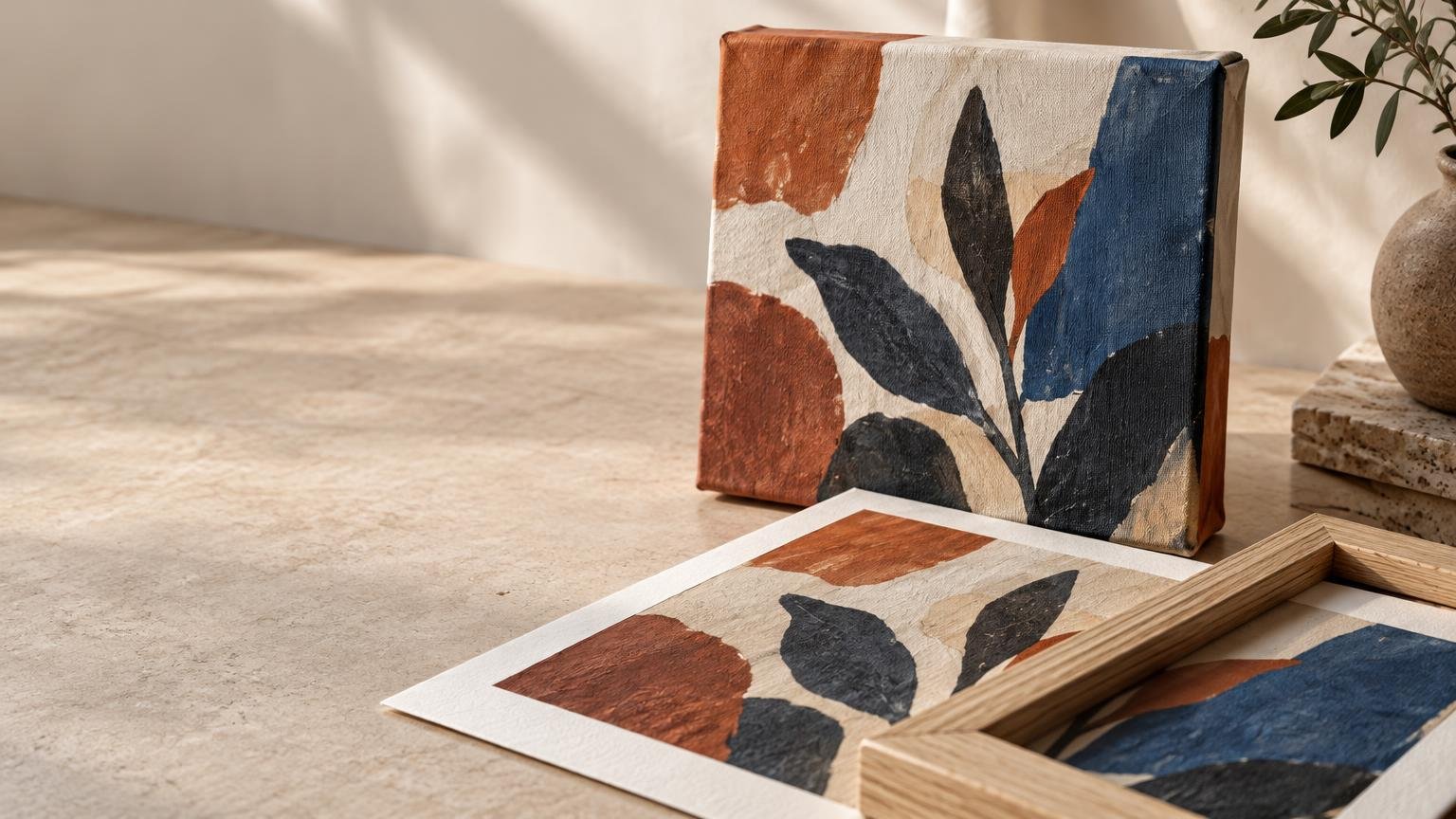
Fine-art paper is the better all-purpose choice for most drawings, watercolors, illustrations, photographs, and detail-rich work. Canvas is the stronger choice when a woven surface and painting-like presentation belong to the visual language of the original—especially for oil or acrylic paintings.
The important question is not which material sounds more premium. It is which one helps the reproduction still feel like your work. Canvas adds a visible woven texture; fine-art paper can be smooth, softly textured, or heavily textured. That surface becomes part of every line, shadow, wash, and patch of color.
TLDR: Choose the surface that supports the original
- Choose canvas for oil and acrylic reproductions, broad painterly marks, large wall pieces, and work that benefits from a stretched, painting-like presentation.
- Choose smooth or lightly textured fine-art paper for detailed drawings, portraits, photography, crisp digital illustration, and work with delicate tonal transitions.
- Choose textured fine-art paper for watercolor, pastel, and other tactile media when the paper texture resembles the original rather than merely adding a decorative effect.
- Order a small proof on each plausible surface before committing to an edition. Inspect fine detail, dark areas, pale color, texture, and the print under the lighting in which it will be displayed.
Canvas and fine-art paper at a glance
| Consideration | Canvas | Fine-art paper |
|---|---|---|
| Surface | Visible woven structure | Ranges from smooth to strongly textured |
| Best fit | Painterly work and canvas-based originals | Drawings, watercolors, photographs, illustration and mixed media |
| Fine detail | Can remain sharp, but the weave affects its appearance | Smooth papers preserve small marks and tonal transitions particularly well |
| Presentation | Can be stretched over bars for a painting-like object | Works well loose, matted, in portfolios or behind glazing |
| Main risk | Texture may compete with delicate marks | The wrong paper texture can flatten or exaggerate the original surface |
| Proofing priority | Check weave, edge treatment and stretched appearance | Check surface texture, paper tone and appearance behind glazing |
When canvas is the better choice
Canvas makes sense when texture is part of the painting’s identity. Canson specifically recommends canvas for reproducing oil paintings when the goal is to echo the texture of the original canvas support. It can also be stretched over wooden bars, creating a presentation that reads more like a painting than a flat print.
That does not mean canvas is automatically soft or low in detail. For example, Canson describes its Museum ProCanvas as a high-resolution, 100% cotton inkjet canvas with a visible surface, offered in matte and lustre versions. The key distinction is that the detail appears through a woven surface rather than on a comparatively flat sheet.
Canvas is most convincing when the added weave feels compatible with the original marks. Broad brushwork, layered color and large shapes can sit comfortably on it. Fine pen lines, tiny lettering, smooth skin tones and subtle gradients require more caution because the weave can become visually active at close range.
Also decide how the edges will work before printing. A stretched canvas may wrap part of the image around the sides, use mirrored or extended edges, or keep the image on the face with a separate border treatment. That decision affects cropping and should be included in the proof rather than left until stretching.
When fine-art paper is the better choice
Fine-art paper gives you a wider range of surface personalities. It is not synonymous with smooth matte paper. A cotton paper such as Canson Edition Etching Rag has a soft texture and matte finish, while watercolor-style papers can have a much stronger tooth. If you are unsure how those finishes change an image, compare matte, glossy and textured paper for art prints before selecting a stock.
Choose a smooth or lightly textured paper when small marks and quiet transitions carry the work. That commonly suits graphite, ink, colored pencil, detailed digital illustration, photography and portraiture. Canson’s portrait guidance favors smooth or lightly textured paper because deep texture can alter the rendering of skin.
Watercolor is the useful exception to the idea that detail always calls for smooth paper. A paper with tooth can echo the original sheet and make the reproduction feel less mechanically flat. Manufacturer guidance suggests using more texture for enlargements and less texture for smaller reproductions where fine detail must remain visible.
Paper also suits artists who want to sell loose prints, place work in portfolios, add a window mat, or offer conventional framed presentation. The Library of Congress framing guidance recommends chemically stable materials and acid-free rag or museum board mats for protective framing. A glazing layer can add physical and environmental protection, although no framing method removes every risk from light, humidity or pollutants.
Do not choose by medium name alone
Two paintings made with the same medium may need different print surfaces. A smooth oil portrait with delicate facial transitions may reproduce more faithfully on a softly textured paper than on a pronounced canvas weave. A bold digital painting designed to resemble heavy brushwork may gain presence on canvas even though no physical canvas was used to create the original.
Judge the image according to what viewers need to notice first. If the work depends on hairline marks, paper grain, restrained shadows or open white space, begin with fine-art paper. If it depends on scale, blocks of color, gestural marks and an object-like wall presence, test canvas. For a textured original, make sure the reproduction surface supports the captured texture instead of layering a second, unrelated pattern over it.
The quality of the digital capture still matters before either material can succeed. Surface choice cannot restore missing detail, correct uneven lighting or remove glare from a poor file. If the original has not yet been digitized, first decide whether you should scan or photograph the artwork for printing.
Archival labels do not settle the decision
Terms such as acid-free, buffered, 100% cotton, OBA-free and ISO 9706 describe useful properties of a print medium. They do not, by themselves, establish how long a completed print will last. Permanence depends on the particular ink, printer, medium, display, glazing and storage conditions.
This is why a longevity figure should be read as a result for a tested system, not as a universal promise for every print bearing the same material label. The Wilhelm Imaging Research report on named Canson media identifies the printer and pigment-ink system used and discusses variables such as glazing, humidity, pollutants and display conditions.
Care matters after printing as well. Keep prints dry, minimize direct sunlight, handle media by the edges and allow the image to dry completely before stacking or packing it. Epson provides that handling guidance for print media, while Canson advises 24 hours of drying before handling its printed canvas.
Make the final choice with a proof
Print the same representative crop on your two strongest candidates. Include a dark passage, a pale area, the finest important mark, a saturated color and any captured texture from the original. View both proofs from normal display distance and then close up.
Choose the surface that preserves the hierarchy of the artwork: the viewer should notice the image before noticing the print material. For most finely detailed or paper-based originals, start with fine-art paper. For work whose character depends on a painted, tactile wall presence, start with canvas. If both versions feel plausible, the proof—not the prestige attached to either material—should make the decision.
References
- Which base should I use for an oil painting reproduction ? | Canson Infinity
- What is a canvas and what is its use? | Canson Infinity
- Museum ProCanvas Water Resistant 385 – Canson Infinity
- Edition Etching Rag 310 – Canson Infinity
- Which paper should I use for printing a portrait ? | Canson Infinity
- S045485Exhibition Watercolor Paper Textured 44" x 50', roll | Epson US
- Which paper should I use for a watercolour art reproduction ? | Canson Infinity
- Preservation Guidelines for Matting and Framing – Collections Care (Preservation, Library of Congress)
- Paper – FAQ – About (Preservation, Library of Congress)
- www.wilhelm-research.com
- Handling Media